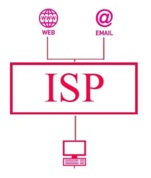
To gain access to the Internet
you need an ISP
(Internet Service Provider).
An ISP is like an onramp
to the Internet.
You pay your ISP for Internet access.
Some providers offer email
and other services,
but access to the Internet
is what you pay for.
My first access to the Internet was
via Compuserve.
i had a 300 baud modem.
The speed of that connection was about 30 text characters per second.
i could type just about as fast as the .3 kbit/s connection could scroll.
In modern terms:
.3 kbit/s (kilobits per second) = .003 Mbps (megabits per second).
Internet speed is measured in megabits per second.
Think of it as a speed scale from 0 to 100.
Modern 56K dialup modems can deliver 56 kilobits / second (.05 Mbps).
That is about one present day digital photo every ten minutes.
Streaming video requires a speed of 3 Mbps or greater.
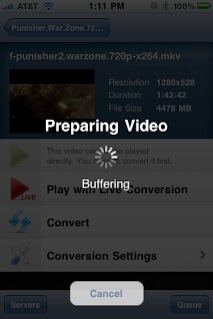
Any slower and the video must stop and wait to buffer.
Buffering is what computers do to allow the video transmission
to catch up to the play head.
The trick is to deliver the video file faster than the video can play.
So what ISPs can deliver the Internet experience you want?
Dialup modem service is still available from AOL
beginning at $11.99 per month.
At a maximum of .05 Mbps,
you will be lucky to read your email.
DSL (Digital Subscriber Line) service is available
through the telephone company.
DSL is a phone connection between your home DSL modem
and the telephone switching station.
Distance to the switch can affect the maximum deliverable speed.
Speed of DSL is between .5 Mbps and 6 Mbps.
The more you pay the faster the connection.
AT&T offers four tiers of DSL service.
Basic: .2 - .75 Mbps $28 per month
Express: .75 - 1.5 Mbps $36 per month
Pro: .156 - 3 Mbps $41 per month
Elite: 3.1 - 6 Mbps $46 per month
Don't bother with a plan less than Elite
unless you like pauses in your video.
If you want to stream Netflix your connection speed should be
greater than 3 Mbps.
Discounts are typically given for the first 12 months for new Internet customers.
Read the fine print.
Fiber optic Internet service, such as AT&T U-verse,
offers speeds ranging from up to 3 Mbps for $38 per month,
to $63 per month for up to 24 Mbps.
Of course, the fiber has to be in your neighborhood.
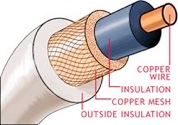
Cable (such as Cox) provides faster speeds.
Traffic on the cable network can affect everyone’s maximum speed.
These are Cox’s plans:
Essential: up to 3 Mbps $44 per month
Preferred: up to 18 Mbps $56 per month
Premier: up to 25 Mbps $68 per month
Ultimate: up to 50 Mbps $100 per month
Don't bother with Essential. Not fast enough.
With Time Warner cable as my ISP, i routinely get 15 - 20 Mbps.
i pay $45 per month for my Internet.
The Internet plays fast and smoothly for me.
Netflix never pauses.
YouTube on full screen? No problem.
Your speed down will be faster than your speed up.
This is called asynchronous.
Today, i have 16 Mbps coming from the Internet to me.
i have 2 Mbps upload.
My total bandwidth is 18 Mbps.
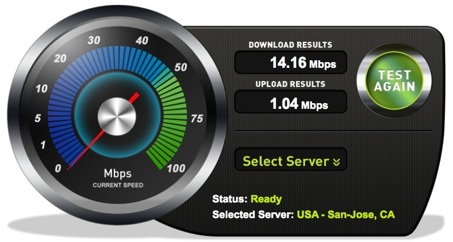
You can check your upload and download speeds at
Bandwidth Place.
Most of what we do on the Internet comes to us, such as
viewing web pages and video or receiving email.
Less often will we send something to the Internet.
Sending email, filling out forms and making DNS requests
use very little bandwidth.
Sometimes you will want faster upload speeds.
Video conferencing, VOIP and large graphic file email attachments
demand faster outgoing speeds.
Business class ISPs deliver synchronous connections.
With a synchronous connection, my 18 Mbps
would be divided into 9 up and 9 down.
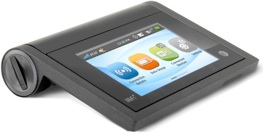
Mobile hot spot hardware,
like AT&T's MiFi, can cost $170.
Speeds average
10 Mbps down and 6 Mbps up.
There are data limits
on the monthly packages.
$40 per month for 1 GB (gigabytes) of data.
$70 per month for 4 GB of data.
Netflix movies will use as little as 0.3 GB per hour for good quality.
HD can use 3 GB per hour.
That's $70 of bandwidth for one HD movie over MiFi.
Satellite Internet services, like dishNET, have data limits too.
$50 per month for 5 GB of data,
up to 5 Mbps speed with 5 GB of Bonus Data.
$60 per month for 10 GB of data,
up to 10 Mbps speed with 10 GB of Bonus Data.
$80 per month for 15 GB of data,
up to 10 Mbps speed with 15 GB of Bonus Data.
(Bonus Data may only be used between 2am and 8am)
As always, ISPs will offer to discount Internet services
if you bundle them with TV and/or telephone.
Google Fiber service
is being installed in various US cities.
The service delivers
1 Gbps for $70 per month.
That's 1024 Mbps.
Wow!
Nuro in Japan (with the help of Sony) is providing 2 Gbps upload
and 1 Gbps download for $50 per month.
Why would you need that kind of speed?
With videos being streamed
to multiple devices in a home,
the data and bandwidth demands are large.
HD and 3D video are data hogs.
If you download an HD movie (about 8 GB of data)
at 3 Mbps it will take 6 hours to download.
At 2 Gbps it will take less than one minute.
Some day soon we will have holographic communications in our homes.
That will require really fast Internet.
Grandma from Florida will be able to stand in the room
with her family in California.
i'm ready to build my Holodeck.
Beam me up Google.
ISP
Saturday, August 24, 2013

weekly hint and rant #238
Click here for this week’s music


714-728-3224
949-734-0056