

Episode #902
May 16, 2026
The saga began when we bought our house.
We shared a well with the vacant lot next door.
The flow of the well was only one and a half gallons per minute. Just to give you some perspective, a showerhead requires 2 1/2 gallons per minute. It didn’t take us long to look into drilling a well on our own property.
The owner of the well company, Eric, was a dowser like his father and his grandfather before him. He walked around my property with a bent coat hanger, which occasionally rotated toward the ground. Each time it rotated, he looked up the grade at the mountain, either smiled or shook his head, and walked to the next spot. I have a theory that Eric was so familiar with the terrain and its hydrology that he could predict where the aquifers were flowing.
He ended up marking three different spots and asking which one I preferred. Paula and I chose one of the spots, and he got to work drilling the hole. He drilled down to about 150 feet and, in the middle of solid granite, broke the drill bit off the rig. He came to me, downtrodden, and said, “I broke a bit, and I can’t pull it out. I have to start again in a different location. Don’t worry, that’s on me.” I found out later that the bit cost him over $10,000.
Eric filled in the hole, and Paula and I picked another spot that the dowsing rod had chosen. In order to turn the drilling rig into position at the new location, the Chamise along our neighbor’s fence had to be removed. He bulldozed the brush that had created a living fence between my neighbor’s and my property. Over the next eight years, we would plant Christmas trees to recreate that fence. But that is another story.
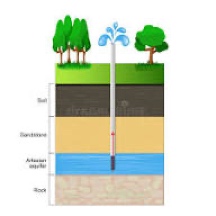
Eric bored the second hole to 600 feet and found an aquifer that produced about 11 gallons per minute. The well pump delivered about 8 gallons per minute. It was plenty for my yard and house.
There was a problem with pulling the water directly from the bottom of the well hole, and that was silt. The silt clogged my landscape valves and drip emitters. A little-known fact is that when landscape valves fail because of silt clogging a diaphragm valve, they fail in the open position. So we had out-of-control water spilling out all over the property. The only solution was to turn off the water, take apart the field valve, clean the entire mechanism and then turn the water back on.
Our well guy added a spin-down filter, which was supposed to clean the silt from the water flow. We still had occasional valve failures. Also, every so often, the aquifer would slow down below the demand of the pump which increased the silt, overcoming the spin-down filter. The solution was to add an external holding tank and an outboard demand pump to the system. The well company installed a 3500-gallon holding tank and placed an 11-gallon-per-minute demand pump to serve the yard and house. The outlet to the holding tank is about 1 foot above the bottom of the tank. This allows a space for silt to settle out. The holding tank is fed slowly, which extends the life of the well pump and reduces the risk of exceeding the flow of the aquifer.
We now have the equivalent of city water at 50 pounds pressure and 11 gallons per minute flow. This water costs only about $7 a month for electricity to run the pumps. More importantly, the landscape watering system works flawlessly.
IF YOU LIKE THIS BLOG YOU’LL LOVE MY BOOKS:
“Skydivers Know Why Birds Sing” by Ricki T Thues is now available on Amazon.
It is a Love story of Rick and Paula Thues and their 35 years of Skydiving.
Click HERE to buy the paperback or Kindle ebook at Amazon.

Follow Ricki T Thues on Amazon HERE.
ALSO AVAILABLE:
“Technically Human” by Ricki T Thues, the iMentor, is available on Amazon.
It is a compilation of selected episodes from this bLog which tell the story of Humanity through the eyes of the iMentor.
Click HERE to buy the paperback or Kindle ebook at Amazon.
The ebook version of “Technically Human” is also available on Kobo. Click HERE.
For you Barnes and Noble Nook readers it is available for Nook. Click HERE.
The “Technically Human” ebook is also available on Apple Books . Click HERE.




I know a lot about wells, water flow, pressure, pumps, tanks, irrigation, and valves, since I’m your neighbor and we had our well pump replaced about 15 years ago. It’s always great to have good clean water when you need it, something we never thought about when we lived in a suburban community with all the utilities provided by the city, but something that became very high on our priority list since water can only be provided by a personal well here in our rural community.
Wow! I’m sure this qualifies as a quest. Good job!