
Episode #923
October 10, 2026
When you use an app like ChatGPT,
it is an application running on a server
in a farm of computers.
The app applies computing to the task of an artificial intelligence collaborating with a user. The application software is a program that executes mathematical routines, with electrons following many miles of microscopic copper interconnects within a computer’s processor, connecting transistors, logic gates, registers, caches, and arithmetic units.
The term program described what programmers created to direct a computer through the step-by-step execution of a task. As programs evolved into tools that helped people accomplish goals, the software program became an application. Then, in true human fashion, application was shortened to app. Nowadays we simply download and use an app.
Today we stream music from the Internet, but we once downloaded digital files. Going back further, we had MP3s on our flash drives, bought music on optical CDs, recorded songs on magnetic tape cassettes, played endlessly looping 8-track tapes, and put on vinyl records (sometimes turning at 33⅓ rpm and sometimes at 78 rpm). Our great-great-grandparents listened to wax or tinfoil cylinders that scratched out the music—or perhaps I should say, cranked it out.
Trivia: Music became groovy because the point of the stylus followed the inexorable groove of a vinyl record, vibrating to reproduce the music. I am cool because the harmony of staying in my groove keeps my emotions balanced and my life on point, like cool (itutu) jazz.
The telegraph (from the Greek meaning writing at a distance) was replaced by the telephone (from the Greek meaning voice at a distance). Telephone was commonly shortened to phone; then, as technology evolved, it became cell phone, mobile phone, and smartphone. Now we have come full circle and simply say, “I have my phone in my pocket.” Ironically, the phone in your pocket is also a telegraph, allowing you to write at a distance with text messages.
We sometimes abandon the original roots. Early computing machines were called computers. As they were introduced to the masses, they became personal computers (PCs). Eventually, this was shortened back to simply computers. Today, however, we often call anything with a computer inside it a device. I wonder if culture will eventually forget the computer altogether and know it only by the shape and function of our devices.
The first large-scale computer network was created by the U.S. Department of Defense’s Advanced Research Projects Agency (ARPA). It was called ARPANET. As other computer networks emerged, we simply called them networks. As those networks became interconnected, we called the result the Internet.
We technicians often illustrated the early Internet as a spider’s web with computers at each intersection. Thus the World Wide Web, or simply the Web, entered our vocabulary. Soon we were simply online or on the Internet. Later, as the Internet became vastly more complex than a spider’s web, diagrams evolved into clouds with lightning-bolt connections. Today, when we are online, we say we are in the cloud.
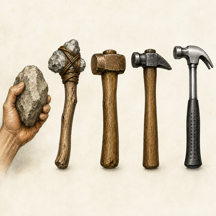
How many of us think of a stick when using a shovel or a rock when using a hammer? Those tools have evolved through technology, and their names have evolved through language. They have become so familiar that we rarely remember their origins.
I think about the roots of things because understanding where something came from helps me understand both its form and its function. That understanding of the past allows me to wield technology more thoughtfully, more confidently, and more effectively today.
IF YOU LIKE THIS BLOG YOU’LL LOVE MY BOOKS:
“Skydivers Know Why Birds Sing” by Ricki T Thues is now available on Amazon.
It is a Love story of Rick and Paula Thues and their 35 years of Skydiving.
Click HERE to buy the paperback or Kindle ebook at Amazon.

Follow Ricki T Thues on Amazon HERE.
ALSO AVAILABLE:
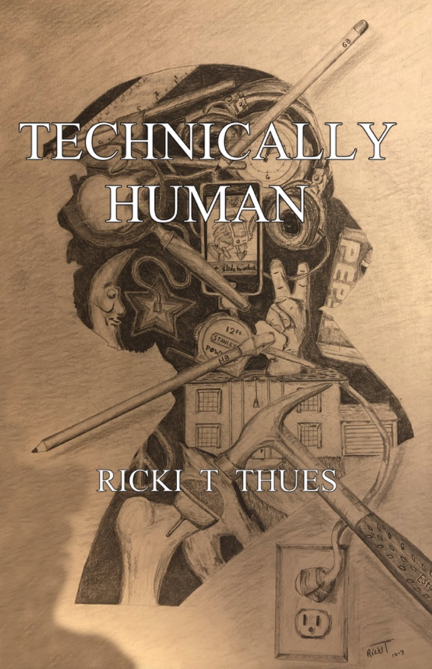
“Technically Human” by Ricki T Thues, the iMentor, is available on Amazon.
It is a compilation of selected episodes from this bLog which tell the story of Humanity through the eyes of the iMentor.
Click HERE to buy the paperback or Kindle ebook at Amazon.
The ebook version of “Technically Human” is also available on Kobo. Click HERE.
For you Barnes and Noble Nook readers it is available for Nook. Click HERE.
The “Technically Human” ebook is also available on Apple Books . Click HERE.
Ricki is also a contributor to the Writers Anonymous short stories anthology, “Matters of Life and Death, Stories on the Brink.” CLICK HERE.

The newest Writers Anonymous short stories anthology, “Stories Well-Traveled,” is now available on Amazon.
It is a collection about the different paths Writers Anonymous has traveled, both real and imagined, and how, through these stories, we have stayed connected.
CLICK HERE.