

Episode #898
April 18, 2026
My wife and I live in a place with an abundance of sunshine.
Several years ago, I bought and installed a rotating clothes line. Paula says that hanging clothes outside in the sun is satisfying, ecological, and fun.
The hole I dug for the ground sleeve was narrow, but when filled with concrete, it seemed substantial enough. With the clothesline pole inserted, the contraption was stable. It worked well for drying clothing.
We also live on a windy ridge. Winds often gust to 30 or 40 miles per hour. One windy day, I found the clothesline lying on the ground. The concrete plug had been pulled from the ground.

I made a larger/wider hole and added more concrete around the old plug.

The sun-dryer lasted many years afterward, but like all machines, the clothesline finally failed. Years in the sun decayed the clotheslines. Constant blowing in the wind caused the pole to weaken and break off. A fragment of the pole was left, stuck in the bottom of the ground sleeve, and could not be removed. I bought a new clothesline.
Some projects teach you more than the manuals ever will. Installing my new Brabantia 40m rotary dryer on my ridgeline, in compacted decomposed granite soil, was one such lesson.
I could not put the new dryer’s pole in the old hole because of the broken off old pole. Also, the new pole was a larger diameter. The good news is that this dryer came with a hammer-in ground sleeve — no concrete required. The bad news is that my ground is compacted decomposed granite. It might as well be concrete.
In spite of a pilot hole that I made with a rebar, driving the ground spike in felt like negotiating with the earth itself. It resisted, unyielding.
I used a wooden 4×4 block to protect the metal sleeve from sledgehammer damage. The hammer met the wood block with great force, and the block split. At first, I blamed my aim, my strength. Then I noticed I had oriented the wood grain on end to the spike. End-grain shattered under the spike’s sharp edges. I cut another 4×4 and placed the cross-grain facing the spike. The grain absorbed and distributed the impact.

This was a small lesson in materials, geometry, and patience. The world reveals its rules if you watch carefully enough.
When the spike was finally seated, the plastic liner had deformed under the pressure of fractured wood fragments. I reshaped the liner with a flat-head screw driver, which allowed the dryer pole to fit into the sleeve. This reminded me that obstacles rarely come alone; solving one often uncovers another, waiting for attention.
When the pole was in place, a subtle wobble telegraphed up its entire length when the dryer turned. This wasn’t failure — it was the system speaking: “I am designed to move, to breathe, to accommodate.” Yet, the desire for refinement drove me to explore PTFE tape as a shim near the base. A few wraps of tape and the clothesline spun smoothly, anchored without binding or wobbling.
A lesson emerged: small adjustments at the root of a problem will ripple through the whole.
This was more than an installation; it was observation, intuition, and gentle engineering in the field. Sometimes, the tools teach you, sometimes the soil, sometimes the wind — and if you’re paying attention, you learn from all of these.
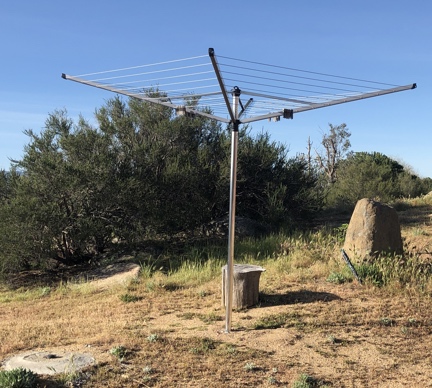
In the end, the dryer stands ready, spinning slowly in the ridge wind, a testimony to care, attention, and the quiet satisfaction of a system coaxed into cooperation.
And perhaps the deeper lesson: the world rewards those who notice what the manual leaves unspoken.
IF YOU LIKE THIS BLOG YOU’LL LOVE MY BOOKS:
“Skydivers Know Why Birds Sing” by Ricki T Thues is now available on Amazon.
It is a Love story of Rick and Paula Thues and their 35 years of Skydiving.
Click HERE to buy the paperback or Kindle ebook at Amazon.

Follow Ricki T Thues on Amazon HERE.
ALSO AVAILABLE:
“Technically Human” by Ricki T Thues, the iMentor, is available on Amazon.
It is a compilation of selected episodes from this bLog which tell the story of Humanity through the eyes of the iMentor.
Click HERE to buy the paperback or Kindle ebook at Amazon.
The ebook version of “Technically Human” is also available on Kobo. Click HERE.
For you Barnes and Noble Nook readers it is available for Nook. Click HERE.
The “Technically Human” ebook is also available on Apple Books . Click HERE.