
Episode #915
August 15, 2026
There is a temptation,
when we speak about animals and humans,
to divide the world too sharply.
We say animals have instinct, and humans have spirit, as though one is biological while the other is spiritual. But what if both words are describing the same underlying phenomenon—the living perception of reality?
A bird waking to a cold dawn does not reason its way into migration, yet when the season changes, something within it changes as well. We call this instinct, but instinct is not a thing the bird possesses; it is the way its inherited body and nervous system are wired and respond to the world. Its perception of reality is already shaped by what it is.
Humans are often described differently, as though we possess something beyond biology called spirit. Yet perhaps spirit is the perceived world of meaning, memory, hope, fear, imagination, and love: the lens through which we experience reality. A bird sees a shadow and reacts; a human sees the same shadow and may attach memory, story, or meaning to it before reacting.
The biologist Jakob von Uexküll proposed that every organism inhabits its own Umwelt—its own perceptual world. A tick lives in a world of heat and scent, a swallow in a world of wind currents and insects, and a human in a world enriched by language, tools, time, and thought. All are real, yet none encompasses reality in its entirety.
Viewed this way, the distinction between instinct and spirit begins to soften. Instinct becomes the inherited structure of living perception in animals, while spirit becomes the self-aware structure of living perception in humans. Both describe a living system encountering reality and generating meaning through those encounters.
There is no need to imagine instinct as a force hidden inside animals or spirit as a separate essence inside humans. Instead, there is continuity of perception, response, and being, with increasing complexity as nervous systems, memory, language, and self-awareness evolve. A bird lives its reality, a dog lives its reality, and a human lives a reality where it can also question itself.
Perhaps, then, the most useful distinction is not between instinct and spirit, but between different degrees of lived reality. What we call instinct and what we call spirit may be different expressions of the same phenomenon on reality’s sliding scale of living perception. If so, the boundary between animals and humans is not a wall, but a continuous unfolding of life, learning to experience the world it inhabits.
IF YOU LIKE THIS BLOG YOU’LL LOVE MY BOOKS:
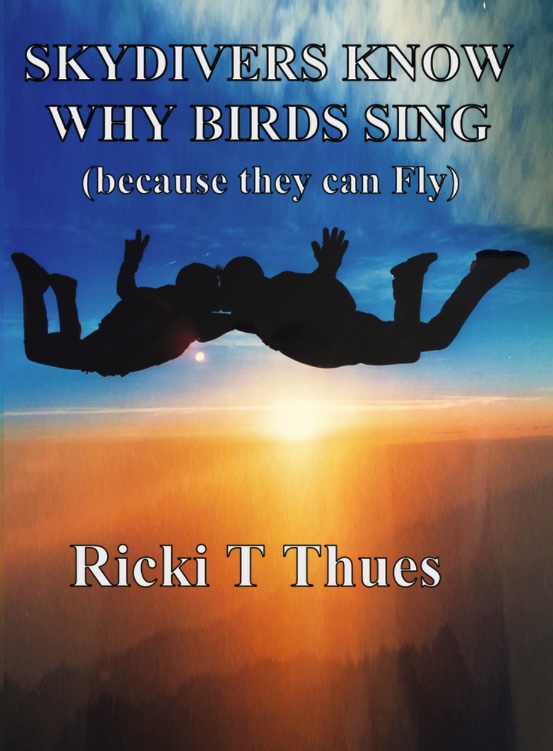
“Skydivers Know Why Birds Sing” by Ricki T Thues is now available on Amazon.
It is a Love story of Rick and Paula Thues and their 35 years of Skydiving.
Click HERE to buy the paperback or Kindle ebook at Amazon.
Follow Ricki T Thues on Amazon HERE.
ALSO AVAILABLE:
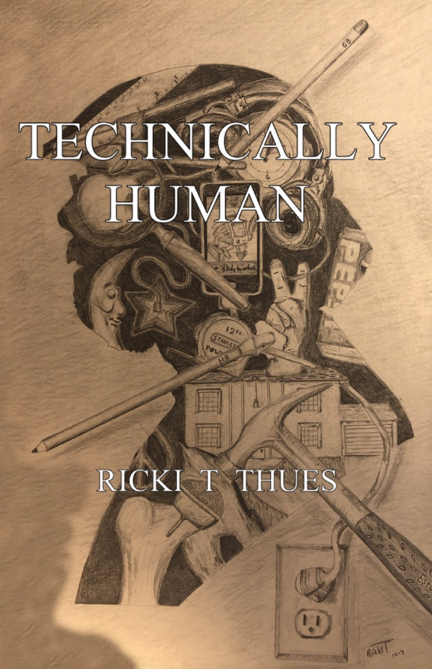
“Technically Human” by Ricki T Thues, the iMentor, is available on Amazon.
It is a compilation of selected episodes from this bLog which tell the story of Humanity through the eyes of the iMentor.
Click HERE to buy the paperback or Kindle ebook at Amazon.
The ebook version of “Technically Human” is also available on Kobo. Click HERE.
For you Barnes and Noble Nook readers it is available for Nook. Click HERE.
The “Technically Human” ebook is also available on Apple Books . Click HERE.
Ricki is also a contributor to the Writers Anonymous short stories anthology, “Matters of Life and Death, Stories on the Brink.” CLICK HERE.
The newest Writers Anonymous short stories anthology, “Stories Well-Traveled,” is now available on Amazon.
It is a collection about the different paths Writers Anonymous has traveled, both real and imagined, and how, through these stories, we have stayed connected.
CLICK HERE.




Your observations tend to blur the distinctions between humans and animals, I think. While there are definite similarities between man and beast, such as in chemistry, the core functions of DNA, proteins, and body plans, the gap is far too great to ignore, especially when it comes to consciousness, rational thought, reasoning, morality, ethics, and creativity.
For some reason, this gap between humans and animals is troubling to many, perhaps because they, as materialists, see this gap as a problem for evolutionary concepts; the notion that we are on a continuum of complexity that arose randomly in some distant and undefined past. Real and apparent gaps in that continuum call the veracity of that continuum into question, and that, in my opinion, is a problem for theorists.
The obvious alternative is that we are uniquely designed by an outside intelligence and the progressive nature of species is a designed order and that man is at the pinnacle of this design and bears the stamp of both the creator and a longing to know and understand that creator. This would explain the obvious gap between animals and humanity, as well as provide answers to the nature and origins of consciousness.
Your well-thought-out and detailed theory reminds me of my own struggle to understand Artificial Intelligence. From an abacus, which calculated by sliding beads, to toggle switches, to registers and memory, to printed circuits that could apply calculation to real tasks, to translating text to speech and speech to text, to memorizing the collective knowledge of man and parsing through it to communicate with its creator. All of this has been incrementally curated by human beings, who are now asking themselves if these computers are sentient. Presently, AI can participate in a sophisticated simulation of introspection. When might that simulation become indistinguishable from actual introspection? 100,000 years from now, the theorists and philosophers might be the machines.
Interesting perspective Ricki!
But, like everything in this world, I find it difficult to put life into boxes. For instance, Corvids are highly intelligent and creative. Parrots and Minah birds talk. I met a parrot once that was capable of conversation. Being a person who has had many encounters with a wide variety of animals, I can say that the ones I have encountered, including wildlife, are capable of gratitude which is a part of the frequency that we assign to the emotion we call love. Birds, in particular, can do it individually or as a collective. It seems to me that the frequency of love is universally recognized by most DNA programs. And conversely, the frequency of fear. Apparently these two frequencies are the most prominently recognized in this dualistic world! So, does programming or spirit drive life? Probably a combination of both.